

Debtor and client risk
You are not lending to your client. You are collecting from their customer.
Every experienced factor knows this and almost no software is built around it. The credit file sits under the client. The exposure sits under the debtor. The two are reconciled by somebody who keeps the whole book in their head, and that person is on holiday next week.
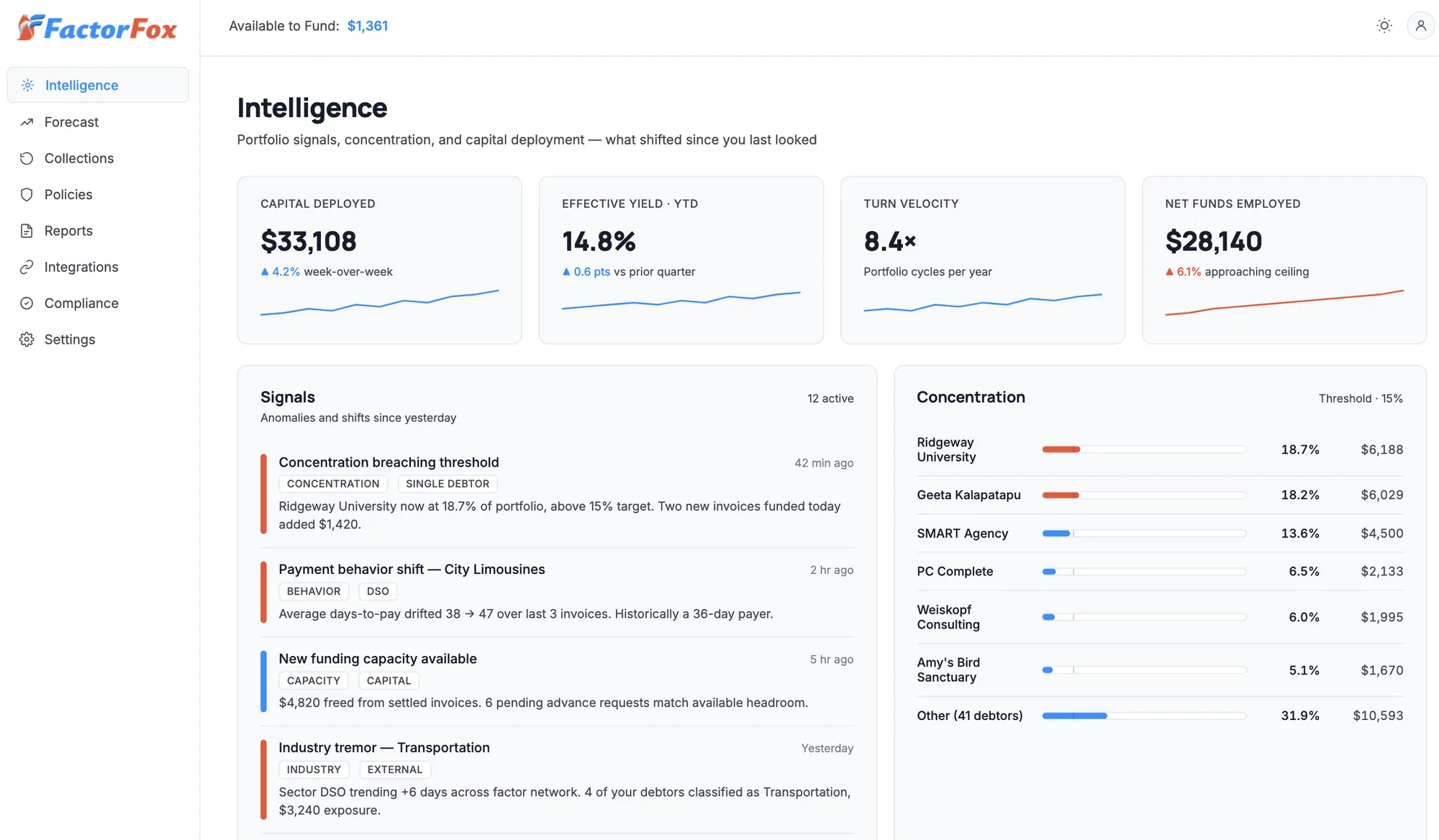
FactorFox monitors the debtor as the counterparty it actually is: across every client that sells to it, against its own payment record, and as a share of your book that moves. This page is written for the credit officer and the risk manager inside a funding company.
The blind spot
Three clients, one debtor, and nobody holding the total.
A factoring book grows client by client. Each file is opened, underwritten and monitored on its own, which is correct as far as it goes. Then a regional distributor starts buying from your third client as well as your first, an account executive brings in a fourth who sells to the same distributor, and the exposure that everyone believes is spread across four relationships is really sitting on one company’s ability to pay.
Nothing on a client screen shows this, because it is not a fact about any client. It is a fact about the debtor, and it only exists when you look across the book from the debtor’s side. In most operations that view is assembled by hand, quarterly at best, and usually because somebody already had a bad feeling.
FactorFox holds both sides of every relationship continuously. Concentration is computed under the debtor name across every client that touches it, not per client, and the finding says which clients contributed the movement. When the share of your book held by one debtor moves, it moves in the morning brief with the reason and the clients named, and it can hold further purchases against that debtor before the next schedule is bought.
The same logic runs on the client side. A client whose paper is drifting into later buckets and whose dilution has started climbing is a different credit than the one you underwrote, whether or not anyone has opened the file this quarter.
What is watched
Four movements that precede almost every loss in this business.
None of these is a threshold on a static value. Each one is a comparison against a baseline drawn from your own book, because that is the only baseline that describes your book.
Concentration migration
Share of the book under one debtor name, now against then, aggregated across every client that sells to it. The finding names which clients moved the number and by how much, so the conversation starts with a fact instead of a suspicion. Crossing policy can hold further purchases against that debtor.
Dilution movement
Dilution tracked as movement rather than reported as a ratio. A client sitting steadily at a known dilution level is a priced risk. A client whose dilution has moved two quarters running is an unpriced one, and the difference is invisible on a report that shows only the current figure.
Payment velocity
Days to pay by obligor, measured against that debtor's own record with your book. A debtor who has always paid at the slower end of terms is not a finding. The same debtor drifting past its own pattern is, and it usually arrives weeks before the aging report notices anything.
Aging tipping
Movement between buckets, not the bucket population itself. Paper crossing from current into the first late bucket in volume tells you something is happening at the debtor now. Waiting for it to reach the bucket where your policy triggers means waiting a further month to learn it.
The counting rule
Exposure at risk is counted once, and the two sides are never added together.
This sounds like an accounting detail. It is the difference between a risk report an operator believes and one they quietly stop opening.
One invoice can be flagged by the client side and by the debtor side at the same time. The client’s dilution is moving and the debtor’s payment velocity has drifted. Both findings are true. Both are worth knowing. If the platform adds them, the same money appears twice and the total is wrong in the direction that causes panic.
So exposure at risk is counted once per account. An invoice contributes its balance to the figure a single time, no matter how many signals touch it. The client side view and the debtor side view are both available, both complete, and never summed into a combined number that describes nothing.
What you get instead is attribution. The total says how much of your book is currently under a live risk finding. Underneath it, each account shows which signals touched it and from which side. A credit committee can then argue about the right thing, which is whether a given account belongs in the number at all.
The same discipline applies to reporting the movement. If there is no prior observation to compare against, the platform does not synthesise one to make the change look measurable. It offers to take a first observation and says plainly that the baseline starts today.
How the total is assembled
| Rule | Behavior |
|---|---|
| One account, one count | An invoice contributes its balance once, however many signals flag it. |
| Sides kept apart | Client side and debtor side totals are shown separately and never added. |
| Attribution kept | Each account carries the signals that touched it and the side each came from. |
| No prior, no delta | Without an earlier observation the platform reports a first observation, not a movement. |
| Coverage stated | Where a source is unconfigured the account says so and coverage falls. |
These are the platform’s counting rules. Any figures shown elsewhere on this page come from a seeded demonstration book.
Day to day
What changes on a Tuesday morning.
Risk monitoring earns its place in the small moments, not in the annual review. These are the ones operators mention first.
What this is not
Monitoring buys you time. It does not make the decision.
FactorFox does not replace your credit judgment, your counsel or your lender. It watches conditions continuously, organizes the evidence, identifies the exceptions and gets them in front of the person with the authority to act while there is still something to do about it. The decision stays where it belongs.
It is also honest about what it cannot see. Several external credit and legal sources are declared rails that answer not configured until you hold the contract and the keys with that vendor. Where a source is dark, the account says so and coverage falls. Nothing is presented as checked because it would look better checked.
And the risk logic does not tune itself. Every weight in it today is a pinned constant. What the platform does hold is the record a calibration loop needs: every finding versioned, every dismissal reasoned and named, every conclusion carrying the evidence it used. That is the groundwork, and we would rather describe it accurately than sell you a learning loop that does not exist yet.
Related
Ask us who your largest debtor really is.
Most operators name a client. Run the debtor side view across a demonstration book and see what the aggregation under one name looks like when three client files are read together.